Ear alone

•December 18, 2009 • Leave a Comment

In the second of the justly famous general introductions to his work W.B.Yeats declared ‘I have spent my life in clearing out of poetry every phrase written for the eye, and bringing all back to syntax that is for ear alone.’  This resonant phrasing has since provoked more embarrassment than scholarship.  The poet though was quite clear about what he meant: ‘I wanted all my poetry’, he said, ‘to be spoken on stage or sung’.  How much this aural intensity and oral imperative must affect its genesis, matter, and direction we are only just beginning to understand.

In a long and detailed study Ronald Schuchard has picked up the gauntlet where Yeats had thrown it and tried to recover through letters, personal accounts, and contemporary articles the history of Yeats’s repeated attempts to have his poetry spoken or sung.  At the book’s heart is Yeats’s ten-year effort to have poetry spoken with careful intonation to a stringed instrument known as the psaltery, a subject on which Schuchard has already penned brief articles.  Its ten chapters however do roam further afield, with the thought of tracing a continuous line from early theatrical performances near the Yeats home in Bedford Park, west London, featuring a beautiful and exquisite verse-speaker called Florence Farr (soon the voice of Yeats’s psaltery performances) right through to an account of Yeats’s innovative radio broadcasts of poetry and music in the 1930s.  Indeed these outside chapters contain the most illuminating material, accounting for Yeats and Ezra Pound’s enthusiasm for the songs of Rabindrath Tagore, describing impressions of Yeats’s verse-speaking at Oxford, and allowing the influence of Farr’s speaking on the burgeoning Imagist movement for once to be seen in proper relief.

There is no doubt that this book represents an important contribution to Yeats studies, and opens up interesting avenues of scholarship when it comes to the story of modernist poetry.  No doubt too that it is meticulously researched, and written in a fine and engaging style, combining a handsome biographical sweep with an economic turning of minutiae – virtues we might expect from the co-editor, with John Kelly, of recent volumes in Oxford University Press’s ever-impressive series of Yeats letters.  That there is finally a frustrating vagueness at its heart is not by any means to dismiss its subject, which matters hugely, nor to impugn its scholarship: rather to acknowledge that writing about words and music is rarely done well.  ‘Beauty is difficult, Yeats’, Pound remembered Beardsley saying: trying to achieve it in poetry performed to music was doubly so, and writing perspicaciously about the results is perhaps scarcely less.  Here, lacunae in musical knowledge hamper the investigation, and because the documentary style eschews analysis of the central questions of tone and poetics raised by Yeats’s experiments, the reader is left with a valuable collection of sources without, quite, convincing narrative direction or real poise in either musical or literary judgment.

Much of this archive material has long lain open to scholars in Yeats’s own obliging scrapbooks of press cuttings, compiled with Lady Gregory and readily available in the National Library of Ireland.  The more remarkable then that so few have, until now, bothered to investigate the fascinating story these cuttings tell, with Yeats’s little-regarded gift for the orchestration of publicity nowhere in better evidence.  Pound one senses learned not only from Yeats’s extreme musical attention but from his political manoeuvring to create what Schuchard provocatively calls ‘the most visible poetic movement in the country’, its concerts in London packed with cognoscenti, provincial lecture tours bringing the ‘new art’ to the populace.  Still, whilst nudging Pound, Joyce, and Eliot to thoughtful creative responses, of Yeats’s experiments many like Bernard Shaw, not unaffected by jealousy of Farr, and even the sympathetic Arthur Symons were sceptical.  Musically literate but rather Wagnerian than avant-garde, critics like these have decisively influenced later generations, and unquestionably the received view of Yeats’s musical collaborations as simply absurd needed a serious corrective.  Schuchard to his credit consistently defends the validity of Yeats’s experiments, and their wider significance.  He does so, however, by appearing to claim their self-consistent integrity.  This fails to acknowledge how Yeats’s methods evolved through new influences (Nietzsche’s particularly pronounced) or show us how changing collaborations and aesthetics produced quite different results, even within one performance.  More seriously, in trying to assert their continuity with a fictional tradition of ‘bardic arts’, Schuchard fatally elides the differences between the widely varying approaches of poets, musicians, and performers through the ages.  Yeats claimed mischievously that ‘all poets from Homer up to date have read their poetry exactly as I read mine’; Schuchard, oddly, seems to take him at his word.  Fluffy generalizing about ‘bardic instincts’ and the ‘lost bardic arts of chanting and musical speech’ only perpetuates the deliberate vagueness that Yeats suffused about his project, and forgets that the poet, for one, barely used such terms after 1900.  Likewise the notion that poetry speaking might restore a ‘lost spiritual democracy’ is simply regurgitated, leaving the intriguing contradictions of an avant-garde, intimately quiet and expressive art of coteries and theatre societies (of which Schuchard has a sure grasp) being rolled out across the country in enormous halls unexplored.  Footnotes to the Collected Letters supply a pithy, ironic commentary too often absent here.

Neither is there any scrutiny of where Yeats’s projects of speaking to music fit into broader musical trends.  How the evolving speech sounds and word-music combinations of composers like Janaček, Peter Warlock, and in particular Schoenberg might relate is never discussed; the arrival of the American Harry Partch gets some coverage, but the lack of a larger musical perspective means Schuchard is often painfully oblique about decisive moments.  The making of the psaltery by the early music pioneer Arnold Dolmetsch as a chromatic instrument of paired octaves tuned in semitones entirely determined the course of the experiments, yet this is just announced, with no motivations or alternatives considered.  As built the psaltery flatly contradicts Schuchard’s unlikely identification of Dolmetsch as the adviser Yeats mentions who ‘thought quarter-tones and less intervals the especial mark of speech’; nor is it credible such a scrupulous editor of music manuscripts advised Yeats to notate the chanting in wavy lines.  A serious lack of musical authority matters because without such rigorous analysis a real grasp of what was actually going on always eludes us.

Finally the book makes little attempt to sound reverberations in Yeats’s own poetry: charitably this is left for others to do.  The one poem explicitly written for Farr to intone (‘The Players Ask for a Blessing on the Psalteries and on Themselves’) is among the worst Yeats ever wrote, and it would have been interesting to hear critical judgement on how Yeats’s collaborations affected his verse, which is ultimately what will matter to the modern reader.  It is a shame that such a sumptuously produced and proportioned book, full of photographs and score-reproductions, misses the opportunity to rescue a Yeats shrouded in mist and subject him to cold-eyed scrutiny.  The book’s achievement will be in bringing some little-considered areas of Yeats’s aesthetic into public light, and picturing the preoccupations of an age.  Patches of cloud and cloudy analysis prevent it from being definitive.

Ronald Schuchard, The Last Minstrels: Yeats and the Revival of the Bardic Arts. Oxford and New York: Oxford University Press, 2008. xxvi + 447pp.  £55.00. ISBN 978 0 19 923000 6.

[To see this article in print see Notes and Queries 56, no.4 Dec 2009]
Reading Joyce

•November 30, 2009 • Leave a Comment

On 16th June 2004 I was at a bar in Dublin explaining Joyce.  The sceptical local who faced me was convinced all the surrounding Bloomsday anniversary fuss was, like Joyce’s novel, ‘a load of bollix’.  I told him reading novels at least twice to get the point was not crazy but like listening to your favourite album more than once; he told me he was a bookmaker with no time for that nonsense.  I told him that, as it had been one hundred years before, this Thursday was the Ascot Gold Cup, and proceeded to give him the prices of 1904, explaining how all drinking Dublin considered the Jewish advertising agent Leopold Bloom ‘cute as a shithouse rat’ for tipping (successfully though inadvertently) the long-odds outsider Throwaway (100-5) to win ahead of the favourite (and following year’s winner) Zinfandel (5-4) – and then not standing any drinks.  This story impressed for just a moment, if it would never entirely convince; but it well illustrates the problem David Pierce’s new book intends in some way to resolve.  Despite an ever-expanding and grossly prolix critical industry Joyce generates many fewer enthusiastic readers than he should.  Reading Joyce is personal account of the problems and pleasures of encountering Joyce written by a distinguished Irish literature scholar explicitly in hopes of finding and guiding new readers to Joyce.  It is in many ways a brave book: that it does not succeed is not to spurn the many pleasures to be had by the way.

Taking as a starting point Joyce’s apparently personal plea in Finnegans Wake ‘Is there one who understands me?’ Pierce sets forth his sense that the word ‘delay’ better encapsulates the reflective attitude Joyce should inspire than that obstructive word ‘difficulty’.  The suggestion is that if the reader will just wait a little the books tend to explain themselves, and if such homespun wisdom as ‘Joyce was extraordinarily reluctant to say what he means’ initially jars, Pierce saves himself by elucidating what he calls the Modernist ‘resistance to paraphrase’, and we understand that Joyce was extraordinarily keen to say not what others meant to say but exactly what they said, nuggets which gather then their own meanings.  The text is framed in eleven chapters and a brief afterword: following a revealing introductory piece we encounter a thoughtful probe into Joyce and his city in 1904; four further chapters on aspects of Dubliners; only one, regrettably, on A Portrait of the Artist; three further chapters concerning Ulysses and student responses; and a final chapter on ‘Figuring out Finnegans Wake’.  It might be deduced from this that Pierce takes a material attitude to Joyce’s texts: he imagines them built from the ground up, from fragments and cityplans in fact, and thus helps us to become familiar with all of Joyce’s cities and their surviving extrusions.  He has less time for Stephen Dedalus’s ethereal wordplay and this commonsense approach is not without compensating subtleties, although as his comments on A Portrait are particularly enlightening, and his heroic unearthing of Sussex Earwickers abundantly fascinating, one might wish for more on these less tangible texts – to take as sample an insight that evidently draws on the author’s own experience: ‘interior monologue […] began long before Dujardin, Joyce and the Modernist novel.  It was known in the Church as mental prayer and, crucially, it included the distractions that accompany mental prayer.’

Such insight represents the best side of what is the most striking characteristic of the book, and this is a narrative threaded with autobiographical reminiscence.  I began with an anecdote for a reason: Pierce’s book is littered with them.  If this is liable to irritate I would suggest reading something else, or only looking at the pictures, which is not as silly as it sounds.  In fact as a Joycean pictorial miscellany this book has few equals, and the treasures Pierce has unearthed will be of inestimable interest to thoughtful scholars, teachers, and students.  Many photographs and images (including maps, bookcovers, and music) I had not seen before, and the author’s musings in the proximate captions on Joyce (‘a boxy sort of mind’) provide entertaining reading.  Yet as we observe Pierce reading or teaching Joyce, visiting his family or revisiting his upbringing the personal stories produced seriously run the risk of banality.  His occasional and unconvincing ventriloquism of Joyce-the-writer (or the voice of Irish nationalism) ignores exactly that resistance to paraphrase he elsewhere commends, while his inclusion of reliably imprecise excerpts from student essays is not always the revelation that was evidently expected.  This is frustrating, as it gets in the way of some real gems of local insight, especially in the latter half of the book.  Pierce evidently believes in the luminous detail, and at his best will take the unfinished sentences of ‘The Sisters’ or words from St John’s gospel and in a few deft touches allow their gleams to illuminate the whole.

All of which suggests that in the flesh Pierce is a very fine teacher, with a gift for the communication of complexities without patronizing his listeners: many handouts and tips are passed on here.  But outside the classroom it is much harder to get the feel of one’s audience: books are not reciprocal events, however much we pretend them to be.  Too often on the point of discovery the narrative lapses into discursive asides, which appear on the page only as strained attempts at ‘relevance’.  Worse, the book seems to miss its intended readership.  Many details are luminous only after much polishing and thus appeal only to those steeped in Joyce, without providing the overall shape a general reader might desire.  In the new reader the book on occasion assumes too much Joycean knowledge; more significantly it is hard to imagine that time-pressed students would not be frustrated by the intrusion of so much circular and frankly unilluminating autobiographical tales.  Pierce does not have Joyce’s gift for concision and resonance in autobiography: well, few do.  But to take on an author with such propensity for transmuting the base metal of personal experience into gold is, however faintly, to set oneself up in competition: tired phrases like ‘then he had to face a different kind of music’ reveal who is the better storyteller.

It is only just to note that in this pervasive spirit of openness Pierce recounts how he was pestered to write the book by his publisher.  Given ‘the demise of critical monographs’ there was, it seemed, a need to make criticism ‘attractive’, especially for Joyce, the great unread.  Pierce responds by attempting to fill a perceived lack: a book that says ‘not “this means that” but “Why should I read this at all?” and “How does any of this connect with my life” and “Please tell me things but make it interesting.”’  In Ezra Pound’s view ‘the critic who doesn’t make a personal statement, in re measurements he himself has made, is merely an unreliable critic’.  Pound though is arguing the critic should not pretend to impersonal objectivity when it comes to questions of value; it is his reasoning, not his biography that should be adduced.  Criticism should perhaps be enjoyable but above all it must be concise and get out of the way, leaving the thing itself to communicate.  So although Reading Joyce marks a noble effort to fulfil the whims of educational publishers, and contains much of value, one can only hope (or pray in that interior space Pierce so well describes) that it does not represent the ‘attractive’ future of academic criticism.  Joyce was a teacher too, we remember; assuming effort but not our overwhelming intelligence, his books knew that only direct contact with us readers ensured they were news that stayed news.

David Pierce, Reading Joyce. Harlow: Pearson Longman, 2008. xviii + 366pp. £14.99 (softback). ISBN 978-1-4058-4061-3.

[To see this article in print see Irish Studies Review, 17:2 (May 2009)]

Galways

•October 20, 2009 • Leave a Comment

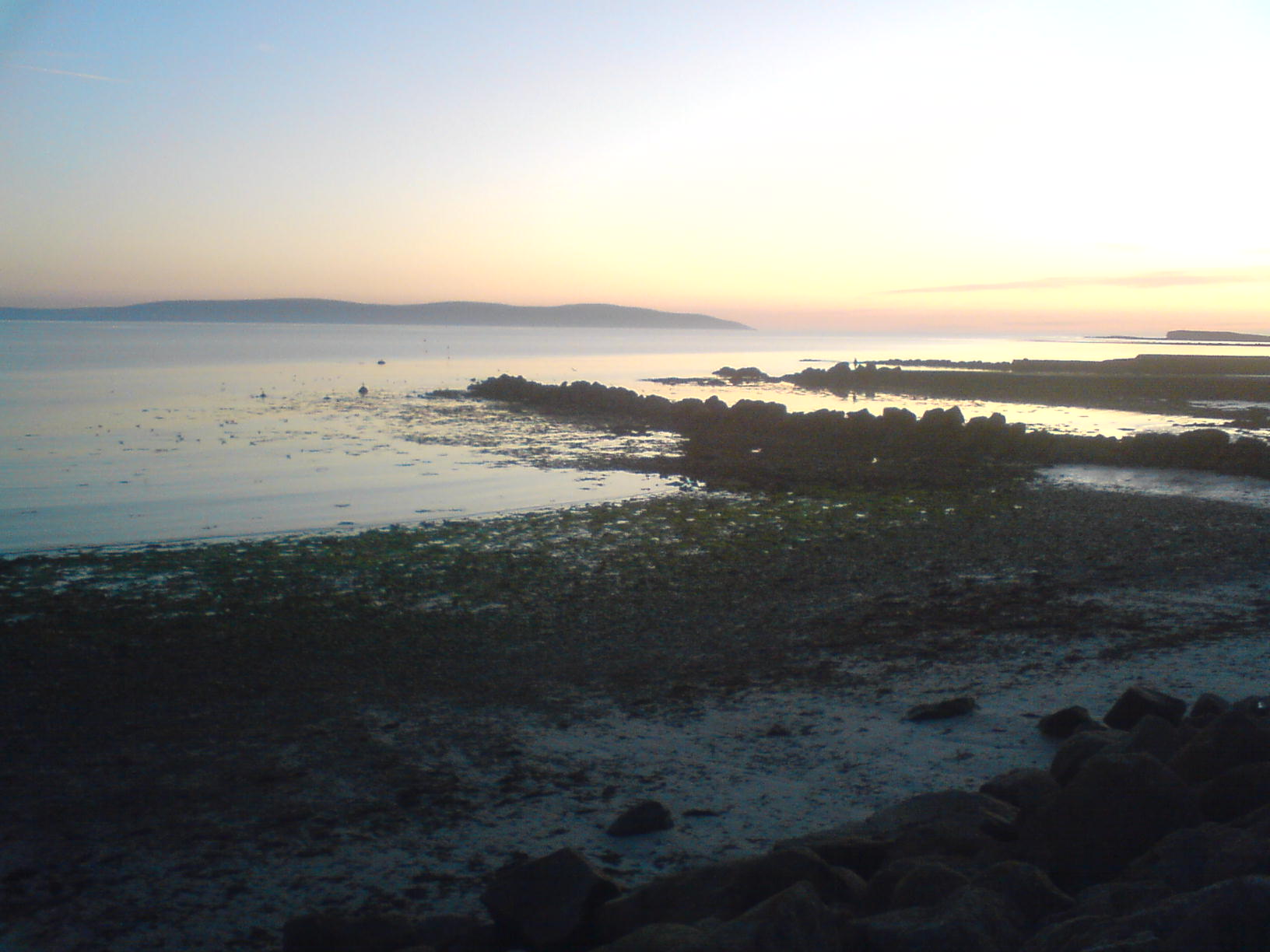
The first thing striking an arriviste about Galway, after you’ve got over all the bars and oysters and musicians that you trip over amongst the medieval city’s small streets, is the water.  This comes crashing down from Lough Corrib via an argumentatively ever-turbulent river, sneaking along in placid canals whose unexpected grey curves defeat the most obstinate of navigational determination, and, there in the most pressing implacable way, the cold bay out to the south.  Not only because this is a town built for fishing and sea-trade you feel its presence everywhere, and you can taste the sea on coming into the town and leaving it, if you wander around the docks or over a bridge or two, or go drinking near the Spanish arch, which unexotically looks as though it might really be for a short railway. Where I live is along the coast road, and what sold me was the walk from the town.  I kept looking left and would have bumped into things, but that the promenade is bare.  You get penetrating wind and I expect plenty of horizontally penetrating rain walking along here, but also wonderful moons when skies are clear, a brisk saltiness in all things, and mountains across the bay.  At least, I’ve been calling them mountains as that is what their looming and brooding seems to deserve.  They are part of that bit of County Clare known as the Burren, known for wildflowers and limestone formations and no trees: and they squat there, gently but immovably sloping, every time I go past and I imagine between times.  Between me and them is a great expanse of water, below, and of sky, above; and all these have a way of combining in infinite variety, glowing and dimming the light in colours that change and change.  Altogether I can’t think of them as hills.  Even though I know that just a good cycle west along the coast the land starts really crumpling up into some properly grand Connemara peaks.   Those are real mountains.

Anyway, greeting my mountains and barring the full whack of the Atlantic is a spit of land that goes to meet them with brief low cliffs, and I have to figure out how to get to this – running at dusk I keep missing and finding other bits of coast, all very interesting but none as romantic and solitary.  Meanwhile running along the strand with head turned seems to act as my tribute.

Which so far happens pretty often.  I take any chance I get to pay my respects to the yellows and misty blues and greens and purples (all the colours A.E. ever claimed were in Ireland); and whenever I cycle back from town there seems to be a glimmering moon over the bay, which adds a silver to the winking lights and dark purple.  Listening to Galway Bay FM as one ought, while unpacking and tidying the house, I overheard the announcement for a 10k run on the following Saturday, helpfully less dispiriting than the half-marathon on the same day.  I thought if I went and looked at my mountains a few more times I might be fit enough to finish in a reasonable time, and so I was, though the wind up that hill at 5k and in the turn towards the finish made life sticky.  Also the pedestrians, who wandered in and around and in front of all the runners as they were enjoying the sunshine, though I had little breath left to berate them.  It seems it’s a habit of those in Salthill when the weather is not abominable to promenade leisurely on the promenade.  The only concession made to economic necessity is to power walk, which means to walk wearing more tight fitting clothes and have a determined expression on one’s face.  And to go without a dog.  This is apparently the limited but legitimate expression of that kind of self-flagellating Puritanism suitable for a country in depression.

And Salthill is in depression.  It once evidently was a mildly thriving seaside spot, along the lines of small 1930s resorts on the English coast (though with better views), but it has within the last ten years faced a double plague of apartment building and now sunken prospects.  So white elephant hotels jostle with bad casinos, picture-framers with fish-and-chips, and the obsessively smart B&B’s with grey paved driveways and hopeful palm trees show an empty face to the world from their double-glazed porches.  I live just a minute or two from the sea up a hill past a mournful leisure centre whose brightly-coloured exterior tubes must be rustily thinking on former glories.  The prospect from my study is the corner of a Gaelic rules football pitch, named of course after (dead Irish patriot) Patrick Pearse, though an enormous new stand, optimistically constructed like so much here, rudely cuts out all but one goal.  On Sundays I can watch maybe a third of a match, but hearing the rest while seeing only a white-kneed goalkeeper pace up and down and then at half-time jog off obediently is unsettling.  Hurling is played here too so then the unseen incidents provoking the loudest jeers and yelps and screams probably involve players taking swings at each other with their sticks.  I keep watching in hopes that a brawl will enter from stage right.

If this is the view outside, inside my flat is capacious and snug all at once. I’ve arranged books and postcards to my taste in the study in order that I’ll want to go in, and have a wonderful large desk which is still virgin tidy.  The kitchen is electric and small but the living room has a fireplace and chimney in which to put a real fire, to me a glorious luxury. I’ve got smokeless fuels and a pile of wood fit to burn a big carbon footprint should I want to, but have only tried one fire, which was mesmerising as they usually are.  Come the darkness of winter I look forward to huddling.  The place is scruffy but none the worse for this – yet to hang pictures over wall stains but I’ll talk to the Salthill framers.  Lots of bathrooms, seemingly too many now the previous occupant has tidied up, and a futon so all very visitor friendly, if I can persuade anyone to brave the wind.

My office in the college has a nameplate and little else – a computer that doesn’t connect to the internet, a view of grass and a driveway, with the awareness of a river beyond – but again its spareness makes it a good place to begin things, as soon as I am Recognised.  I won’t go into the extent of a bureaucracy that might have shamed Kafka, as it is starting to seem more tiresome than amusing and I want to think Higher Thoughts; but it does raise interesting philosophical questions about how anyone proves they exist.  Descartes wrestled with this, but then he wasn’t locked out of a computer system.  I think therefore I’m not.  My only consolation is the mountains, which are indubitably there.

Perfect Pitch

•September 30, 2009 • Leave a Comment

I think this is more interesting than it sounds.  Anyway, it’s a summary of my project…

Perfect Pitch: Music and Poetry in Ireland from Moore to Muldoon

Music in Ireland is never abstract: here it has always meant something.  Already saturated by language and notions of cultural and political survival, music has in all its complex inflections influenced poetry like no other force.  This study uncovers music’s role in defining and causing poetry, from its formal structures to its habitual self-image, and shows how the presence of both actual music and ideas about music has indelibly coloured the aesthetics of poetry in Ireland.  Broadly the research examines the sustained use poets of the last two centuries from have made of music: as metaphor, imaginative touchstone, and structural principle; but also as political weapon, as medium for words in performance, as translational gesture, and even as replacement for language.  More narrowly it consists of linked studies of poets and groups of poets from Thomas Moore to Paul Muldoon which explain in precise terms how adopting musical forms, ideas and imagery decisively shaped what they wrote and (crucially) how it was disseminated, thereby shaping an entire literary culture.  Music and poetry in Ireland have an unstable but inextricable relationship: this study seeks to find out why this adopted intimacy is so intractable and influential, and to examine in detail the extraordinary variety of artistic manifestations this has produced.

Wild Irish Nationalisms

•September 30, 2008 • Leave a Comment

Despite its solemn intent, Lady Morgan’s The Wild Irish Girl is a silly book. Still, for what is a rickety plotted, extravagantly overwritten, stagy and dragging novel it has proved notwithstanding wildly influential: for two centuries its effect on the discourse of cultural politics has been profound.

Lady Morgan (Sydney Owenson), The Wild Irish Girl. 1806. ed. Kathryn Kirkpatrick (Oxford: Oxford University Press, 1999) xxiv + 266pp. £7.99.

Europe Unstrung

•September 30, 2008 • Leave a Comment

To combine political nuance with personal reflection is a trick many poets have tried: nearly all have failed. That Louis MacNeice pulled it off it time and again might seem a testament to his age, I suppose, but really should be put down to an energetic, exacting, chameleonic mind with an extraordinary breadth of reference, sympathy, and vocabulary. It must also I think reveal a talent for succinct storytelling, the results of which can be seen in this ‘unfinished autobiography’, reissued last year on the anniversary of the poet’s birth.

This coruscating book is indispensable reading for anyone interested in the England of the inter-war years, in Northern Ireland, the Spanish Civil War, Anglo-American relations, or in the falling of impressions on the mind of a poet whose gifts translate beautifully into prose. MacNeice visits Jack Yeats, brother of the poet and Ireland’s most important painter, and describes him ‘slashing the paint on thick but with subtle precision, building up obscure phantasmagorias, combining an impressionist technique with a melodramatic fancy’. Apart from missing MacNeice’s acute political sensibility and knack for synthesis this describes his own prose quite well, though the results are not much like Jack Yeats’s paintings: the dreams which are woven through the text, and MacNeice’s penetrating exaggerations about nations and people and politics are somehow as true to life as any more sober reflection.

The book begins in America in 1940, but dives back to take in MacNeice’s upbringing in cold, stony, Carrickfergus under the eye of his Protestant rector father. Still, the atmosphere of sun and fields in this early recollection might be put down to the presence of his mother, who seems to have brought life and love to the household before becoming suddenly depressed and ill, and finally leaving for a nursing home when the poet was only five and a half. A year later she died of tuberculosis (as we are informed by a note by Louis’s sister), and Louis was left with little but biting memories of his few minor sulks and indiscretions towards the end and a picture of her ‘walking up and down the bottom path of the garden, the path under the hedge that was always in shadow, talking to my sister and weeping’. The family is taken on by a flinty nanny and the memoir becomes fittingly granity: ‘showing off’, as Louis learns, is now considered a sin.

Fortunately it is a lesson MacNeice never fully learnt.  At school in England he adopts the character of an outsider, playing on his Irishness to form a make-believe persona, and clinging to what Louis reports as his father’s nationalism.  At Marlborough and Oxford MacNeice’s self-possession is disturbed but we see his poetic sensibilities develop, especially in a gift for friendship.  His marriage and domestic life in Birmingham are intimately described, although a real sense of MacNeice’s feelings is obscured: as in his poetry, he acts chiefly as an acute observer.  It is in this role he travels to Iceland and to revolutionary Spain, and his scepticism about absract political idealism is cemented.  His political engagement however is not diminished.

The memoir circles back to where we began, and we now understand what takes MacNeice to America is a private rendezvous, about which he is reticent, not simply the public concerns we have assumed.  His privacy in a memoir is surprising, but he takes a classical view of the public demands of the writer: and as a Tiresias figure we realize his insight and his wanderings are not over.  The autobiography itself closes with a memoir from MacNeice’s longtime friend opening up new avenues into his personality.  The text is collated by MacNeice’s longtime friend the classicist E.P.Dodds and sparingly annotated.  But as a insight into its times as much as its author it has few equals.

Louis MacNeice, The Strings Are False: An Unfinished Autobiography. London: Faber & Faber, 1965, 2007. 288pp. £9.99.

The Language Question

•July 4, 2008 • Leave a Comment

Discussing a book in translation is a perilous business. When that book is an excoriating assault on language ignorance and misperception, we must tread ever so warily: we are beyond the pale without a paddle. Yet Flann O’Brien’s An Beal Bocht (1941) (The Poor Mouth – an accent is sadly missing on the e of Beal here) deserves to be read and known beyond the small circle of those with enough Irish to appreciate it. Patrick Power’s vigorous 1973 translation, available from HarperCollins with wonderfully damp and smudged ink illustrations from Ralph Steadman which only deepen the book’s atmosphere of rain and squalor, is a masterpiece of assimilation, requiring surprisingly few notes to explain the kind of language in-jokes in which O’Brien delighted and which (with comic overcrowding) populate the book.

Our narrator, born with the unlikely name of Bonaparte O’Coonassa, emerges (with fine emotional Gaelic speech) into a West of Ireland of exaggerated poverty and exposure, its inhabitants perversely delighting in their dismal situation: ‘One afternoon I was reclining on the rushes in the end of the house considering the ill-luck and evil that had befallen the Gaels (and would always abide with them)…’. In fact, they behave as the books and politicians would have them behave: admiring the stark beauty of the countryside, bewailing (I almost said bewaeling) their miserable fate but not thinking to put up a shed to house the cows and sheep and pigs that fight and copulate and smell out the house. The brutality of outsiders is not minimized: reciting his long heritage at school Bonaparte, ‘son of Michaelangelo, son of Peter, son of Owen, son of Thomas’s Sarah […]’ is struck down and told he is ‘Jams O’Donnell’; later, imprisoned for twenty-nine years, he is cruelly heartened by the no doubt mistaken belief he has at last found his father, a man who also has been taught to identify himself as Jams O’Donnell. But exposing such ludicrous harshness of naming cuts many ways: the arrival of Gaelic enthusiasts to the west brings with them a plethora of adopted names of half-understood Irish: ‘The Sod of Turf’, ‘The Temperate Munsterman’, ‘The Dative Case’, ‘The Gluttonous Rabbit’ and even ‘Yours respectfully’ – the name ‘The Branchy Tree’ providing a nod to the pseudonym of Douglas Hyde, founding President of the Gaelic League and later President of Ireland, the architect of the language revival which provides O’Brien with his chief target.

As usual with O’Brien, it is difficult to find an assumption or orthodoxy not satirized: he takes Swiftian pleasure in exposing everyone and everything: the absurdities of language revivalists, including those zealous preservers of the language who mistakenly record pigs with gramophones believing them to be speaking the finest (i.e. most difficult) Irish, the inhumane dismissals of English-speakers, the ignorance, superstition, and helplessness of the (fictional) peasantry, the exaggerated misery of first-person narratives in Irish now vastly popular (‘in one way or another, life was passing us by and we were suffering misery, sometimes having a potato and at other times having nothing in our mouths but sweet words of Gaelic’), and thus the unthinking audience for these monstrosities, and the idea of appealing to any abstraction embodying Ireland (later satirized in his newspaper columns by the appearance of ‘The Plain People of Ireland’). Really anyone that tells us to think anything, and we for allowing them, are attacked; but with savage wit rather than indignation. Hence the complex ironies of this speech opening the Grand Feis of Corkadoragha, from the President, one ‘Gaelic Daisy’, who builds into an ecstatic self-fulfilling eulogy of the whole notion of speaking Gaelic in the Gaeltacht:

– Gaels! he said, it delights my Gaelic heart to be here today speaking Gaelic wiht you at this Gaelic feis in the centre of the Gaeltacht. May I state that I am a Gael. I’m Galeic from the crown of my head to the soles of my feet – Gaelic front and back, above and below. Likewise, you are all truly Gaelic. We are all Gaelic Gaels of Gaelic lineage. He who is Gaelic will be Gaelic evermore. I myself have spoken not a word except Gaelic since the day I was born – just like you – and every sentence I’ve ever uttered has been on the subject of Gaelic. […] He who speaks Gaelic but fails to discuss the language question is not truly Gaelic in his heart; such conduct is of no benefit to Gaelicism because he only jeers at Gaelic and reviles the Gaels. There is nothing in this life so nice and so Gaelic as truly Gaelic Gaels who speak in true Gaelic Gaelic about the truly Gaelic language. I hereby declare this feis to be Gaelically open! Up the Gaels! Long live the Gaelic tongue!

Saying something is so, even in Gaelic, doesn’t make it so. The usual blackly comic tone shifts, here as elsewhere, into a kind of relish in the absurd possibilities of language and action. O’Brien’s puns and games and tones of voice and rhetoric do seem to delight in the craft of manipulating words. More and more it seems the freedom, the anarchy the artist in language makes possible is surreptitiously but implacably asserted. On all sides of the language divide pieties are demolished, and one would think mutual understanding was being urged. And yet the book works through the comic possibilities of mutual incomprehension: the individual and his prejudiced and unteachable understanding is finally its hero. O’Brien knew well that language created power, but rarely final authority; in this gap he conducted his guerrilla war.

Above all, of course, the book is ruthlessly funny, and this must be its recommendation. This utter lack of ruth in the humour persists. After the opening of the feis, and another earnest speech in Gaelic wondering if anyone at all is really in earnest about Gaelic we are told ‘not only one fine oration followed this one but eight. Many Gaels collapsed from hunger and from the strain of listening while one fellow died most Gaelically in the midst of the assembly. Yes! we had a great day of oratory in Corkadoragha that day!’. As in his better-known At-Swim-Two-Birds (1939), that spectacular double-helix of modernist self-consciousness, O’Brien remorsely satirizes the urge, the need of us all to talk, to speak, to write, and at length. Yet it was an urge he deeply understood: despite never producing the string of exceptional novels his early promise predicted, he fought off the distractions of employment and drink to labour for years at his caustic and occasionally brilliant Irish Times daily newspaper column (in Irish and, increasingly, in English) ‘Cruiskeen Lawn’. And, for all he might have accomplished, having The Poor Mouth in English is not a poor substitute.

Flann O’Brien, An Beal Bocht. 1941. The Poor Mouth. 1973. trans. Patrick C. Power. London: HarperCollins, 1988, 1993. 128pp., £7.99.

The Untilled Field

•July 2, 2008 • 2 Comments

…so to speak. Meaning, a beginning, a tabula rasa, signs on a white field. And, yes, George Moore’s 1903 collection of short stories, quite possibly the best thing he ever did, even including his amused and scurrilous memoirs Hail and Farewell (1911). Certainly it is hard to surpass the poignant dissection of nostalgia that is ‘Home Sickness’, a excoriating but finally forgiving examination of the contradictions of always living in one place and longing for another, cutting a sharp silhouette of American-Irish relations and opening an illumination into the appeal of the ‘Ireland’ formed in the mind’s eye. Following Bryden from the bar-room in New York’s the Bowery to the west of Ireland and back again, it is a testament to the illusory but irresistible powers of the imagination, here cast as restlessness. Bryden leaves New York for a place more vision than memory, makes a home in Cork and is on the point of marrying Margaret, who looks at him with ‘a woman’s soul’ out of ‘soft Irish eyes’. But anything of romantic cliche in the narrative is culled as he remembers the obedience and passivity of the country and its people, and simply abandons her for accents and trains and politics, the smell of the bar-room. Feeling in the city ‘the thrill of home’ Bryden marries; but we learn from two final surgical paragraphs that, on retirement, his children gone and wife dead, he returns, hopelessly, in mind, and can see only a memory of Margaret, and a persistent landscape of green hillside, bog lake and rushes, and ‘behind it the blue line of wandering hills’. The untetherable, capricious nature of human consciousness is nowhere better described.

The priests, spoiled priests, and farming families populating in these sensitive stories, with all their frustrations and glimpses of joy, were a huge source for Joyce’s Dubliners and for Frank O’Connor’s own scrupulous Corkmen, as O’Connor himself identified in his provoking analysis of the short story, The Lonely Voice (1963). Moore’s exquisite volume deserves to be better known: if it is an uneven patchwork, veering just occasionally towards an unconvincing Kiltartan dialect, at moments it reaches the heights of Turgenev and the best Russian short stories, and remains in the memory longer than most collections of the next hundred years. It is available in a recent cheap paperback edition from Colin Smythe, with a comprehensive introduction by Richard Allen Cave.

George Moore, The Untilled Field. 1903. Gerrards Cross: Colin Smythe, 2000. intr. Richard Allen Cave. xxxiii + 224 pp. £7.99